



ROI Analysis of B2B Appointment Setting Providers
Every dollar you spend on B2B appointment setting either builds a pipeline or burns budget, and the difference comes down to one thing: knowing how to measure what you’re actually getting back. For sales leaders and revenue operations teams evaluating B2B appointment setting providers, the stakes are high. Poor provider selection stalls growth cycles and drains your sales team’s momentum.
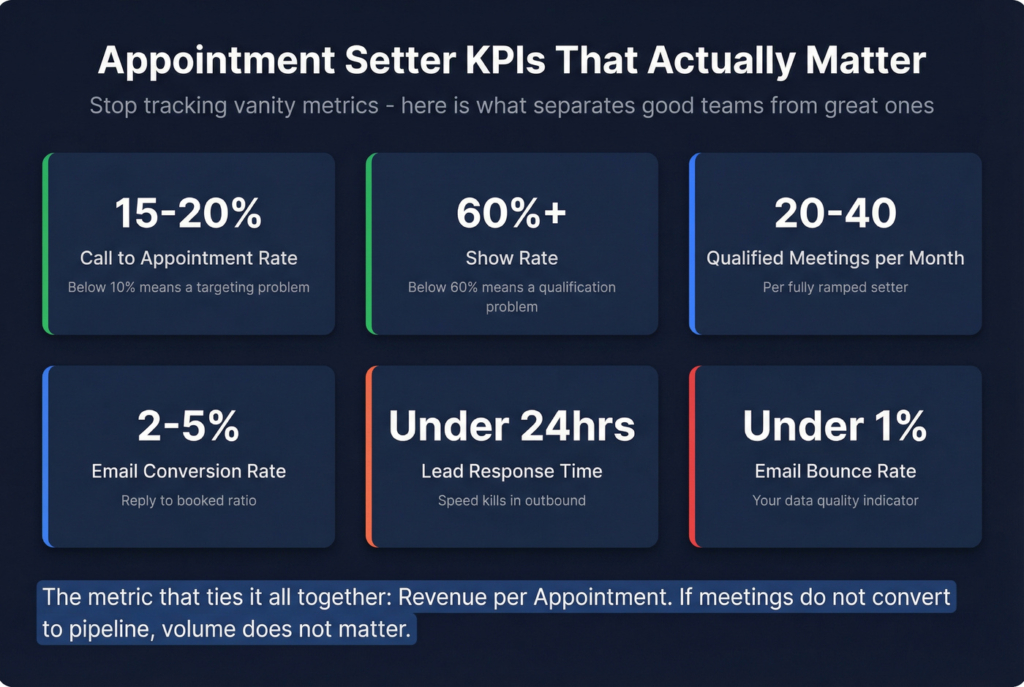
The market for outsourced appointment setting has grown significantly, yet many companies still struggle to connect provider costs with measurable revenue outcomes. In practice, teams often confuse activity metrics, like calls made and emails sent, with true performance indicators tied to closed deals and pipeline value.
Choosing the right provider without a clear ROI framework is like hiring a sales rep without a quota. The intent may be right, but the accountability is missing.
This guide walks through everything you need to evaluate provider ROI objectively, while providing a clear definition of what B2B appointment setting ROI actually means.
Quick Takeaways
- High-quality appointment setting drives measurable pipeline, not just meetings.
- ROI depends on conversion rates across the full funnel, not just cost per meeting.
- Data quality, targeting, and nurturing significantly impact returns.
- Integrated providers often deliver stronger long-term ROI than siloed vendors.
What Is B2B Appointment Setting ROI?
B2B appointment setting ROI measures the financial return generated by your investment in securing qualified sales meetings. It’s a straightforward ratio: revenue attributed to appointments set versus the total cost of generating those appointments. However, calculating it accurately is more nuanced than it first appears.
ROI encompasses the full value chain, from the cost per appointment to the average deal size, sales cycle length, and close rate. A booked meeting that never converts adds zero return, while a poorly tracked win can make underperforming campaigns look profitable.
What typically happens is that companies undercount costs (overlooking management time, tooling, and ramp-up) or overcount returns by ignoring attribution complexity. Both distort the picture.
Clearly understanding this definition sets the stage for breaking down the specific components that drive, or drag, your ROI numbers.
Components of ROI in Appointment Setting
Understanding ROI as a single number tells only part of the story. Meaningful ROI analysis depends on tracking the right components, which are the inputs and outputs that actually determine whether your appointment setting program is generating real value.
Components to measure include:
- Cost per appointment (CPA): Total spend divided by appointments booked.
- Show rate: The percentage of scheduled meetings that actually take place.
- Qualified meeting rate: How many appointments meet your ideal customer profile criteria.
- Pipeline contribution: The total deal value generated from set appointments.
- Close rate from set appointments: How often qualified meetings convert to closed revenue.
Show rate is one of the most overlooked metrics, yet a low show rate can quietly destroy ROI even when appointment volume looks healthy. According to EBQ, tracking conversion at each stage of the funnel is essential to diagnosing where value is being lost.
The strongest appointment setting programs treat ROI as a multi-layered metric, not a single calculation. Each component above acts as a diagnostic lever, identifying exactly where your program is thriving or leaking budget.
The ROI Formula for Appointment Setting
With the key components clearly defined, the next step is putting them together into a working calculation you can apply to your own program.
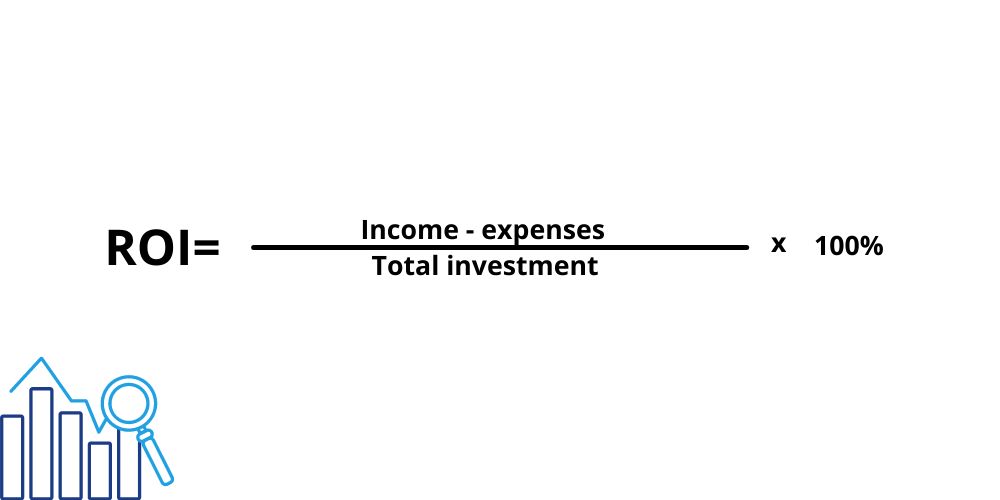
The formula is straightforward:
ROI (%) = [(Revenue Generated – Total Investment) / Total Investment] × 100
Applying this formula requires accuracy at every input. Your total investment should include provider fees, internal coordination time, CRM licensing, and any sales enablement materials. Your revenue-generated figure should reflect closed deals directly attributed to appointments set, not pipeline value, which remains speculative until a contract is signed.
For example, a company spends $18,000 on appointment-setting services over one quarter. Those appointments yield three closed deals worth $12,000 each, which total $36,000 in revenue. The ROI calculation: [($36,000 – $18,000) ÷ $18,000] × 100 = 100% ROI.
Tracking cost-per-appointment alongside conversion rates gives the clearest picture of program efficiency.
Accurate ROI measurement depends entirely on clean attribution, knowing precisely which revenue traces back to set appointments versus other pipeline sources.
However, this formula only captures what’s visible. There are less obvious value drivers that many companies miss entirely when evaluating providers.
Hidden ROI Drivers Most Companies Overlook
Once you’ve calculated your baseline ROI using the formula covered earlier, it’s worth asking: Are you capturing everything that appointment setting actually delivers? Most companies focus exclusively on closed revenue, but several high-impact value drivers regularly go unmeasured.
Pipeline acceleration is one of the most underrated factors. Qualified appointments compress your sales cycle by delivering pre-educated, pre-qualified prospects, meaning your team spends less time on discovery and more time closing. Shorter cycles free up capacity, which compounds ROI across the entire program.
Brand familiarity among target buyers is another overlooked variable. Every outreach touchpoint, even those that don’t convert, builds market familiarity with your solution.
Additional hidden drivers worth tracking include:
- Sales team morale and focus: Reps who aren’t cold prospecting close at higher rates.
- Data enrichment: Outreach campaigns generate validated contact intelligence with ongoing value.
- Competitive displacement intelligence: Conversations reveal objections and competitor positioning patterns.
These secondary returns don’t always show up in a single-quarter ROI calculation, but they meaningfully affect long-term program performance. Keeping them in mind becomes especially important when evaluating how different provider models stack up against each other.
Comparing ROI Across Provider Types
Not all appointment setting providers deliver the same returns, and understanding what drives those differences matters before committing your budget.
There are three primary provider models to evaluate:
- In-house teams: Highest fixed costs (salaries, benefits, training, technology), but maximum brand control and institutional knowledge.
- Freelance or contract SDRs: Lower overhead, though inconsistent performance and limited scalability are common trade-offs.
- Outsourced B2B appointment setting agencies: Typically, the fastest path to pipeline volume, with built-in infrastructure, trained reps, and established outreach systems.
Outsourced providers often deliver stronger short-term ROI for companies that lack an established sales development function. However, their performance varies significantly based on industry expertise, data quality, and outreach methodology.
The provider type that generates the highest ROI is not always the cheapest, but the one most aligned with your sales cycle, target market, and deal size.
How to Measure B2B Appointment Setting ROI Effectively
With a clear picture of provider types and hidden value drivers in mind, the next challenge is putting a reliable measurement system in place that captures the full picture, not just surface-level metrics.
Effective ROI measurement starts with tracking the right inputs and outputs consistently:
- Cost per appointment: Total program spend ÷ qualified meetings delivered.
- Pipeline contribution: Total deal value generated from booked appointments.
- Win rate from set appointments: Closed deals ÷ total appointments attended.
- Time-to-revenue: Average days from first appointment to signed contract.
One practical approach is establishing a 90-day measurement baseline before drawing conclusions. Appointment setting programs typically require a ramp period, and early data can be misleading.
Accurate measurement also demands tight CRM hygiene, as every appointment must be tagged to its source so attribution stays clean across the funnel. According to Salesmotion, the top-performing companies are 81% more likely to use their CRM tools on a regular basis, but it’s impossible to do so when the data is all jumbled.
Providers who offer transparent reporting dashboards make this process significantly easier, which points directly to why the structure of your provider relationship matters so much for long-term performance.
Turn Conversations Into Revenue with Televerde
If your current appointment setting strategy is generating activity but not results, it’s time to rethink your approach.
Televerde helps B2B organizations move beyond vanity metrics and connect appointment setting activity to measurable pipeline and revenue outcomes. With a fully integrated model spanning demand generation, lead qualification, and customer experience, Televerde delivers measurable ROI at every stage of the funnel.
Connect with Televerde today to start building a pipeline that converts.
Frequently Asked Questions
What is a good ROI for B2B appointment setting?
A strong ROI typically ranges from 3:1 to 5:1, but high-performing programs can exceed this when targeting and conversion rates are optimized.
How do you calculate B2B appointment setting ROI?
Use this formula: [(Revenue Generated − Total Investment) ÷ Total Investment] × 100. Your revenue figure should reflect closed deals attributed to set appointments; your total investment should include all provider fees, internal time, and tooling costs.
Why do some appointment-setting programs fail to deliver ROI?
Common reasons include poor targeting, low-quality data, lack of nurturing, and weak alignment between marketing and sales teams.
Is outsourced appointment setting better than in-house?
Outsourced providers often deliver faster results and scalability, especially when they offer integrated services like demand generation and data management.
What metrics matter most for ROI?
Focus on opportunity creation rate, deal conversion rate, average deal size, and pipeline velocity, not just meetings booked.