



How to Staff a Contact Center to Your Volume Curve, Not the Clock
Summary
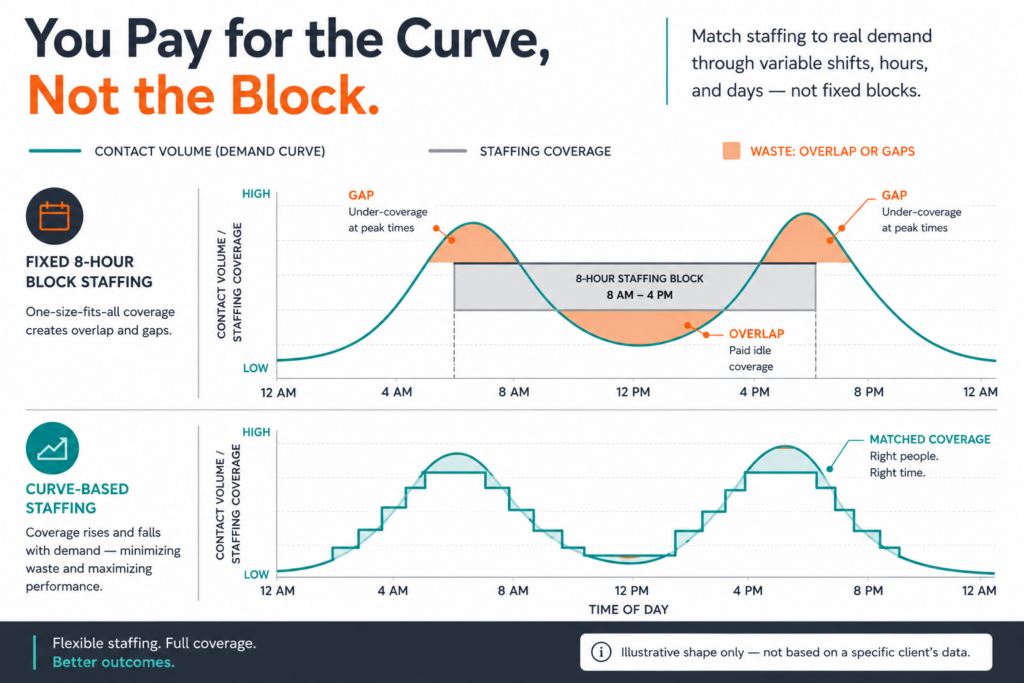
Most contact centers staff in fixed 8-hour blocks and then shuffle those blocks to chase demand. That guarantees two problems at once — overlap (paying for idle agents during slow periods) and gaps (too few agents during spikes). Staffing to the actual volume curve, using variable shifts, hours, and days matched to when demand happens, lowers cost-to-serve and protects customer experience at the same time. The principle is simple: you pay for the curve, not the block.
Most contact center operations are staffed in 8-hour blocks. You hire agents for fixed shifts, then slide those blocks around the day to try to match demand. It feels orderly. But run that math against a real volume curve and it never quite lines up.

Why does fixed-block staffing fail against real demand?
Demand doesn’t arrive in 8-hour increments. It arrives in peaks, dips, and surges that move by hour, day, and season. When full shifts are the only unit you have to work with, you end up doing one of two things: stacking coverage you don’t need during slow stretches, or leaving thin spots during the busy ones. Usually both, on the same day.
That gap costs more than it looks. Labor is the single largest line in a contact center budget — widely cited industry research puts it at roughly 60–70% of operating costs (ContactBabel). So every hour of overlap is spend on idle capacity, and every gap shows up exactly where customers feel it: longer waits, more abandons, lower CSAT.
What does staffing to the volume curve mean?
A volume curve is the actual shape of contact demand across a day, week, and season — when calls, chats, and tickets rise and fall. Staffing to the curve means building coverage around that shape rather than around fixed shift lengths.
Televerde doesn’t start with the shift. We start with the curve. Instead of forcing demand into 8-hour blocks, we build staffing around when volume actually happens — variable shifts, variable hours, variable days. If your volume climbs at 9 a.m., flattens at 1 p.m., and spikes again at 4 p.m., your coverage should do the same. The schedule follows the work, not the clock.
What does curve-based staffing look like in practice?
Picture an operation with a predictable mid-day lull. Under a fixed-block model, you’d staff straight through it and pay for agents sitting idle — or cut the shift short and scramble when the afternoon peak hits. Matched to the curve, the same coverage can be split: agents work the morning peak, step away during the quiet middle, and return for the afternoon rush. Full coverage when it counts. No paid idle time in the trough.
[Editor note: the split-shift scenario above is illustrative, not a confirmed client engagement detail. The Securus outcomes cited below are verified from Televerde case studies; the specific mid-day split mechanic is not attributed to them. Replace with a confirmed real example if one is available.]
Does demand-matched staffing actually work?
It does. When Securus faced unpredictable, high-volume demand, Televerde’s flexible, demand-matched model cut call abandonment from 27% to under 5% and brought wait times down from over 30 minutes to under two — while making staffing adjustments that could be activated in under two hours, even during unplanned events.
A fixed-block model optimizes for scheduling convenience. A curve-based model optimizes for the two things operations leaders actually answer for: cost-to-serve and customer experience. You stop paying for coverage you aren’t using, and you stop losing customers in the gaps.
How do you tell if your own staffing is mismatched?
Pull your last 30 days of volume by hour and day, then lay your current staffing pattern on top of it. The overlap and the gaps tend to show up fast. If they do, it’s worth a conversation about what staffing to the curve would change.
Want to see how your coverage lines up against your actual demand? Let’s talk.
FAQ
What is a volume curve in a contact center?
A volume curve is the pattern of customer contact demand over time — how call, chat, and ticket volume rises and falls across the hours of a day, the days of a week, and the seasons of a year. Staffing decisions are most efficient when they follow this curve rather than fixed shift lengths.
Why is fixed 8-hour-block staffing inefficient?
Because demand doesn’t move in 8-hour increments. Fixed blocks force a choice between over-covering slow periods (paying for idle agents) and under-covering peaks (longer waits and higher abandonment). Most operations experience both on the same day.
How much of a contact center’s cost is labor?
Widely cited contact center industry research places labor at roughly 60–70% of operating costs (ContactBabel). Because labor is the dominant expense, mismatched staffing wastes the single largest line in the budget.
What’s the difference between staffing to the curve and staffing to the clock?
Staffing to the clock starts with fixed shift lengths and tries to fit demand around them. Staffing to the curve starts with actual demand and builds variable shifts, hours, and days around it — reducing idle coverage and closing peak-time gaps.