



The Tenure Curve: Why Quality Breaks at Scale (and What Fixes It)
Summary
Contact center quality breaks at scale not because processes fail, but because the agents executing them keep turning over. Training, QA calibration, and escalation mapping are table stakes every BPO can show on paper — but they don’t predict performance under volume. The variable that does is agent tenure. When average tenure is low, an operation is permanently re-ramping: every departure resets the training and QA investment for that agent’s accounts. The fix is structural, not procedural — a workforce that stays, so the experience you paid to build is still on the line when your volume doubles.

Every outsourcer has a quality story. It usually comes with a training curriculum, a QA scorecard, and a clean escalation diagram. Lined up side by side, most of them look interchangeable — which is exactly the problem. Then real volume shows up: a product launch, a seasonal surge, a backlog that doesn’t clear by Friday. That’s the moment you find out which quality stories were ever real.
Here’s what rarely makes it into the evaluation: the processes you’re comparing aren’t the differentiator. The people running them are.
The table stakes everyone clears
Pre-volume training. QA calibration cadence. Escalation mapping. These matter. An operation without them will struggle from day one. But they’re the floor, not the ceiling — table stakes any credible partner can produce in a deck.
The reason they don’t predict how quality holds up is that they describe a system on paper. They say nothing about whether the agent who learned your product, your tone, and your escalation paths is still on the line six months from now. That single variable — agent tenure — is what actually determines whether quality survives scale. And almost no one puts it on the scorecard.
What is the Tenure Curve?
The Tenure Curve is the widening gap in service quality, as volume grows, between an operation whose agents keep turning over and one whose agents stay.
Picture a simple chart. The horizontal axis is volume or scale, moving left to right as your contact center grows. The vertical axis is quality — pick your metric: QA score, first-contact resolution, CSAT.
Two lines.
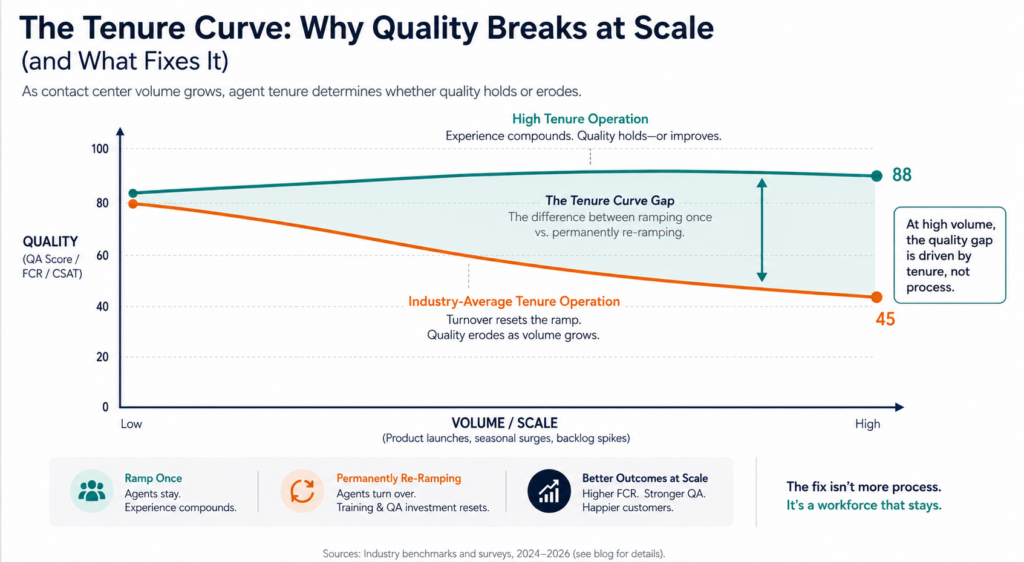
The first is the industry-average line. It starts at a respectable level, then sags as volume climbs. Not because the processes failed, but because the people executing them keep turning over. At typical contact-center attrition, every wave of new volume gets absorbed by agents still climbing the learning curve. Quality erodes precisely when the business needs it most.
The second line is what it looks like when tenure holds. It stays flat — or bends upward — as volume increases, because the team scaling into the work already knows the account. Experience compounds instead of resetting.
The gap between those two lines is the Tenure Curve. It’s the difference between an operation that ramps once and an operation that’s permanently re-ramping.
Why tenure compounds
A new agent doesn’t reach full productivity on day one. Industry data puts the ramp at roughly six to eight months to reach the performance level of an experienced agent — and that’s before you account for the client-specific product, systems, edge cases, and escalation logic on top. Every departure resets that ramp, not just for the person who left, but for whoever inherits their accounts. Training investment and QA calibration get spent again on ground you already covered.
Now layer in the turnover math. Average call center agent tenure is commonly cited at around 12 months (13–15 months in recent 2026 surveys), and most departures happen inside the first year. So if the ramp takes six to eight months and the average agent is gone around twelve, an operation never fully escapes the ramp phase. It’s always onboarding, always recalibrating, always a little behind the experience curve. Add volume to that, and the gap only widens.
What changes when tenure is the design, not the accident
Televerde’s average agent tenure is roughly 4.5 years — about four to five times the industry norm. Concretely, that means the agent who learned your product and escalation paths a year ago is, in all likelihood, still the one answering when your volume doubles. The institutional knowledge you paid to build stays in the building.
Tenure like that doesn’t happen by accident. It’s downstream of an engaged, committed workforce — low absenteeism, agents who show up and stay — which is the same thing that keeps quality steady when the queue gets long.
How should you evaluate a BPO partner?
If you’re comparing outsourcing partners on process maturity and certifications alone, you’re comparing floors. Every serious vendor clears them. The real question — the one that predicts whether your CSAT survives your next growth spurt — is simpler: will the team executing the process still be there next year?
That’s the differentiator hiding behind every quality promise. It’s worth asking about directly.
If quality holding at scale is the question on your mind, let’s talk through what your operation actually looks like under volume — and where tenure is quietly helping or hurting you today.
FAQ
What is the Tenure Curve?
The Tenure Curve is the widening gap in customer service quality, as contact center volume grows, between an operation whose agents constantly turn over and one whose agents stay. Low tenure causes quality to sag under volume because each departure resets the training and QA investment; high tenure lets quality stay flat or improve because experienced agents already know the account.
Why does contact center quality drop as volume increases?
Quality usually drops not because processes fail, but because agents turn over faster than new ones reach full productivity. As volume rises, more of the work is handled by agents still on the learning curve, so QA scores, first-contact resolution, and CSAT decline at the exact moment the business needs them to hold.
Are training and QA processes enough to maintain quality at scale?
No. Training, QA calibration, and escalation mapping are necessary but they are table stakes — most credible BPOs can demonstrate them. They describe a system on paper and say nothing about whether the agents who learned your product are still there months later, which is what actually determines whether quality survives scale.
How does agent tenure affect first-contact resolution and CSAT?
Tenured agents resolve more issues on the first contact because they already know the product, systems, and escalation paths, which lifts first-contact resolution and CSAT. High turnover has the opposite effect: institutional knowledge is lost with each departure and the new agent who inherits the accounts has to re-learn them.
What is the average tenure of a call center agent?
Industry data commonly puts average call center agent tenure at around 12 months, with recent 2026 surveys citing 13 to 15 months. Most departures occur within the first year, and new agents typically need six to eight months to reach the performance level of experienced staff — which is why high turnover keeps quality from stabilizing. By comparison, Televerde reports an average agent tenure of roughly 4.5 years, about four to five times the industry average.
How can you tell whether a BPO’s quality will hold at scale?
Look past process maturity and certifications, which most serious vendors clear, and ask about agent tenure and attrition. The most predictive question is whether the team executing the process today will still be there a year from now, because that is what keeps quality steady as volume grows.