



What a Repeat Contact Really Costs in Your Contact Center (and Why Your Average Hides It)
Summary
A blended “cost per contact” metric averages cheap first-contact resolutions with expensive repeat contacts, hiding the true cost of unresolved issues. A repeat contact costs roughly double a resolved one. At 65% first-contact resolution, more than a third of your volume quietly costs twice as much — and the lever is FCR, not added headcount.

Your cost-per-contact number looks fine. That’s the problem.
Most contact center dashboards report a single blended figure — total cost divided by total contacts — and it usually lands somewhere reassuring. Say $8 a contact. Leadership sees it, nods, and moves on. But that one number averages together two very different things: the contacts you resolved cleanly the first time, which are cheap, and the contacts a customer had to make twice, which are not. The healthy-looking average is doing exactly what averages do — smoothing over the part that’s costing you.
Why does a repeat contact cost roughly double?
A repeat contact costs about twice what a first-contact resolution costs because the customer has to come back, and almost everything about that second interaction is more expensive. There’s a second round of handle time. The customer is frustrated, so the conversation runs longer. The agent has to re-read the history or re-diagnose from scratch. It’s more likely to escalate. And both interactions consume queue time on your end and wait time on theirs. One unresolved issue, two contacts, double the cost — and that’s before you count the customers who call a third time.
This matters more than most teams realize, because the repeat rate is rarely small. Research from SQM Group, a customer experience benchmarking firm, puts the average contact center’s first-contact resolution (FCR) at around 70% — meaning roughly three in ten contacts are repeats. Plenty of centers run below that, in the mid-60s. At 65% FCR, more than a third of your volume is the expensive kind.
What does that actually cost? A worked example.
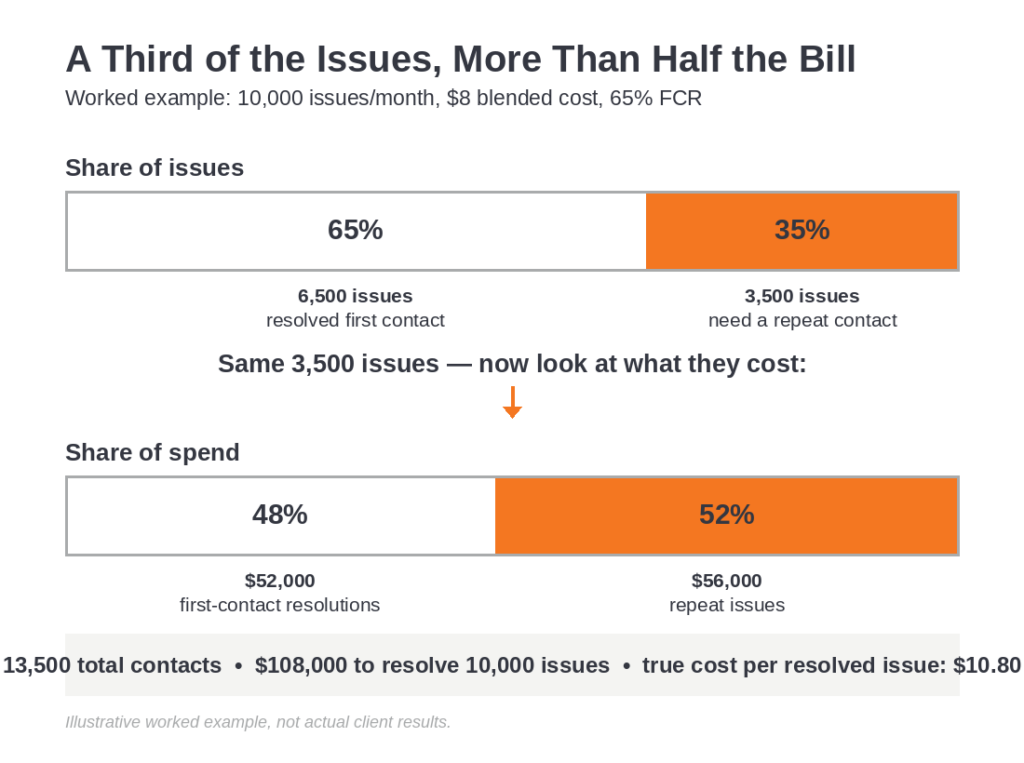
Take a month of 10,000 issues, a blended cost of $8 per contact, and 65% FCR.
- 6,500 issues get resolved on the first contact: 6,500 contacts × $8 = $52,000.
- 3,500 issues don’t, and each needs a second contact to close: 7,000 contacts × $8 = $56,000.
That’s 13,500 contacts and $108,000 to resolve 10,000 issues. Notice what just happened: the unresolved third of your issues consumed more than half the spend. Your dashboard still says $8 per contact, but the true cost per resolved issue is $10.80 — and a repeat issue specifically costs you about $16, double a clean one. In practice it’s usually more, because that second contact runs longer than the first.
Why first-contact resolution — not headcount — is the lever
The instinct when costs climb is to add seats. But the repeat-contact line doesn’t shrink with more agents; it shrinks when more issues get solved the first time. Move FCR from 65% to 75% — ten points — and on those same 10,000 issues, repeat issues drop from 3,500 to 2,500. That’s 1,000 fewer callback contacts a month, about $8,000 less in monthly cost, or roughly $96,000 a year. Same volume, same headcount, lower spend.
Ten points sounds like a lot, but it usually isn’t a technology problem. Most repeat contacts trace back to a handful of fixable causes: thin Tier 1 training, weak routing that sends customers to the wrong place, and gaps in the knowledge agents can reach mid-call. Tightening those is the kind of work that tends to show results inside about 90 days, without adding a single seat.
One caveat: gains only hold if the team holds
An FCR gain is built on agent skill — the routing, the product depth, the judgment to resolve something the first time. If the people who reached 75% turn over, the number slides back and the repeat tax returns with them. Tenure is what protects the improvement, which is why low-attrition teams tend to hold their FCR gains while high-churn teams keep re-earning them.
If you want to pressure-test these numbers against your own — your real cost per contact, your real FCR, what ten points would actually free up — we’re happy to walk through it with you.
FAQ
How much more does a repeat contact cost than a first-contact resolution?
Roughly double. An unresolved issue requires at least a second interaction, and that second contact tends to run longer — the customer is frustrated, the agent re-diagnoses the issue, and it’s more likely to escalate. A contact that costs $8 the first time effectively becomes a ~$16 issue once it repeats, and more if the customer contacts a third time.
Why doesn’t “cost per contact” show the cost of repeat contacts?
Because it’s a blended average. It divides total cost by total contacts, mixing cheap first-contact resolutions with expensive repeats into one number. The average can look healthy while a third of the underlying volume costs double. To see the real picture, track first-contact resolution (FCR) and repeat-contact rate alongside cost per contact.
What is a good first-contact resolution (FCR) rate?
Industry benchmarking from SQM Group places the average contact center around 70% FCR, with 80%+ considered strong. Below roughly 70%, repeat contacts make up a large enough share of volume to materially inflate your true cost per resolved issue.
Can you lower contact center costs without cutting headcount?
Yes. Raising FCR removes repeat contacts — the most expensive volume — so the same team resolves the same issues with fewer total interactions. A ten-point FCR gain on 10,000 monthly issues at $8 per contact removes about 1,000 contacts a month (~$96,000 a year) with no change in staffing.
If you want to pressure-test these numbers against your own — your real cost per contact, your real FCR, and what ten points of improvement would free up — let’s walk through it together.