


How Much Revenue Is Leaking Through Your Customer Experience?
Summary
CX revenue leakage is the revenue lost (or left unrealized) when customer interactions fail to protect retention, strengthen renewals, resolve issues effectively, or uncover legitimate opportunities for growth. It typically appears across six areas:
- access and responsiveness
- resolution and effort
- churn signals
- renewal risk
- missed expansion
- and operational performance
The challenge is that much of this leakage goes unnoticed because customer service is still measured primarily as a cost center rather than recognized for the role it plays in protecting and expanding revenue.

How Much Revenue Is Leaking Through Your Customer Experience?
CX leaders have spent years measuring the customer experience. NPS, CSAT, customer effort, complaint trends – the data makes it clear where customers are frustrated and where experiences fall short. Most leadership teams understand that. The bigger question now is: What is that friction actually costing the business?
What’s still missing in many organizations is the ability to translate customer experience into financial impact. CFOs and boards think in revenue, margin, retention, and cost-to-serve, while CX teams often report on satisfaction, sentiment, and effort. Until those conversations connect, customer experience remains viewed as a service function rather than a driver of financial performance – and it gets funded, staffed, and prioritized accordingly.
That gap has a name: CX revenue leakage.
CX revenue leakage is revenue that’s lost (or never realized) when customer interactions fail to protect retention, support renewals, resolve issues well, or identify legitimate growth opportunities. It’s not the same as billing leakage, pricing leakage, or contract leakage — those live in finance and revenue operations, and they’re usually tracked. CX revenue leakage lives in the interaction itself: the call that goes unanswered, the issue that takes three contacts to close, the renewal conversation that never happens because no one owned it.
Why NPS and CSAT don’t tell the whole story
NPS, CSAT, and customer effort score are still useful. They tell you how a customer felt about an interaction. What they don’t tell you is what that feeling is worth — whether it’s the difference between a renewal and a churn, or a quiet expansion opportunity that never got routed anywhere. Sentiment tells you how the customer feels. Revenue leakage tells you what those experiences could cost the business.
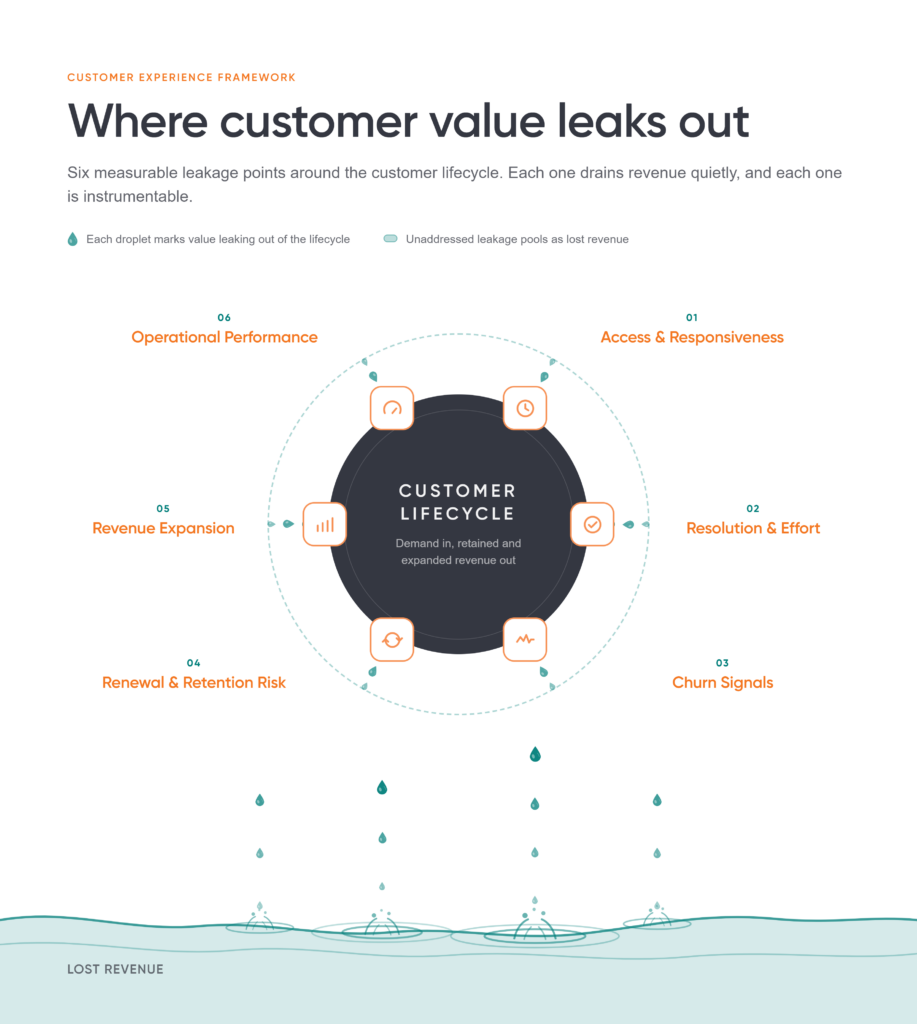
When you look at CX through a revenue lens, leakage typically surfaces across six key areas:
Access and responsiveness. Long waits, abandoned contacts, and limited availability don’t just frustrate customers — they cause them to disengage before an issue is even resolved. A customer who gives up on a call doesn’t stop having the problem. They just stop bringing it to you, which is a worse outcome for both sides.
Resolution and customer effort. Every repeat contact, transfer, and unresolved issue adds friction the customer didn’t sign up for. You’re investing more time and resources into an issue that should have been resolved the first time.
Churn signals. Customers often signal their risk of leaving before they actually do. Through their tone, language, repeat concerns, or the questions they begin asking. The warning signs are often already present in the interaction. Revenue leakage occurs when those signals go unrecognized or no one is accountable for acting on them.
Renewal and retention risk. Customers approach renewal dates constantly through the year, not just in the weeks before the contract is up. When there’s no proactive support built into that runway, renewal becomes a reactive scramble instead of a relationship that was maintained the whole way through.
Revenue expansion. Customers regularly reveal legitimate, unprompted needs in service conversations — a use case they haven’t solved, a team that needs more seats, a problem your product already handles. When there’s no path for that information to reach the people who can act on it, the opportunity closes itself.
Operational performance. Turnover, training gaps, inconsistent quality, and capacity constraints don’t stay contained to the operations side of the business. They show up in every one of the five areas above, and they raise cost-to-serve while they do it.
None of these losses show up on a P&L line labeled “customer experience.” They show up later, scattered across churn, flat expansion revenue, and a cost-to-serve number nobody can quite explain. That’s what makes CX revenue leakage difficult to manage: it’s real money, moving in the wrong direction, without a name attached to it.
The financial stakes here aren’t small. Qualtrics XM Institute’s Q3 2025 global consumer study — more than 20,000 consumers across 14 countries — found that 34% of customers reduce spending with a company after a bad experience, and 13% cut spending entirely. Across markets, that puts nearly $3 trillion in global sales at risk in 2025 alone. 1 Most of that risk never gets traced back to a specific service interaction. It just shows up later as softer revenue.
This is also where it’s worth being direct about what this isn’t. Recognizing CX revenue leakage doesn’t mean turning every service call into a sales opportunity, or asking agents to pitch when a customer just wants their problem solved. The goal is narrower and more useful than that: recognize what’s actually happening in the conversation, resolve the issue well, and make sure the right signal reaches the right person when there’s something worth acting on. That’s a very different job than selling.
Customer service can protect revenue and support growth without becoming a sales function. But that only happens when leaders start treating service interactions as a source of financial exposure and opportunity — not just a transaction to close as fast as possible.
Before you can fix CX revenue leakage, you have to know where it’s coming from. That starts with one question:
Where is revenue most vulnerable across your customer lifecycle?
1 Qualtrics XM Institute, Businesses Risk $3 Trillion in Sales From Poor Customer Experiences as Consumers Cut Spending, based on a Q3 2025 global consumer study of 20,001 consumers across 14 countries, published November 12, 2025.
FAQ
What is CX revenue leakage?
CX revenue leakage is revenue a company loses or fails to capture when customer service interactions don’t protect retention, support renewals, resolve issues efficiently, or surface legitimate expansion opportunities. It’s distinct from billing or pricing leakage because it originates in the interaction itself, not in a financial process.
How is CX revenue leakage different from a low CSAT or NPS score?
CSAT and NPS measure how a customer felt about an interaction. CX revenue leakage measures what that feeling is worth financially — whether it puts a renewal, an expansion opportunity, or the relationship itself at risk. Sentiment scores are an input; leakage is the financial outcome.
Where does CX revenue leakage typically hide?
Six places: access and responsiveness, resolution and customer effort, unrecognized churn signals, unmanaged renewal risk, missed revenue expansion signals, and operational performance issues like turnover and training gaps that raise cost-to-serve.
Does addressing CX revenue leakage mean turning customer service into a sales function?
No. The goal is to resolve issues well and route legitimate signals to the right team — not to script agents into pitching. Recognizing a signal is not the same as selling.